| vf_node_pictures_all | title (item) | field_cer_web | field_cer_navbox | g_geofield | g_geofield | |
|---|---|---|---|---|---|---|
|
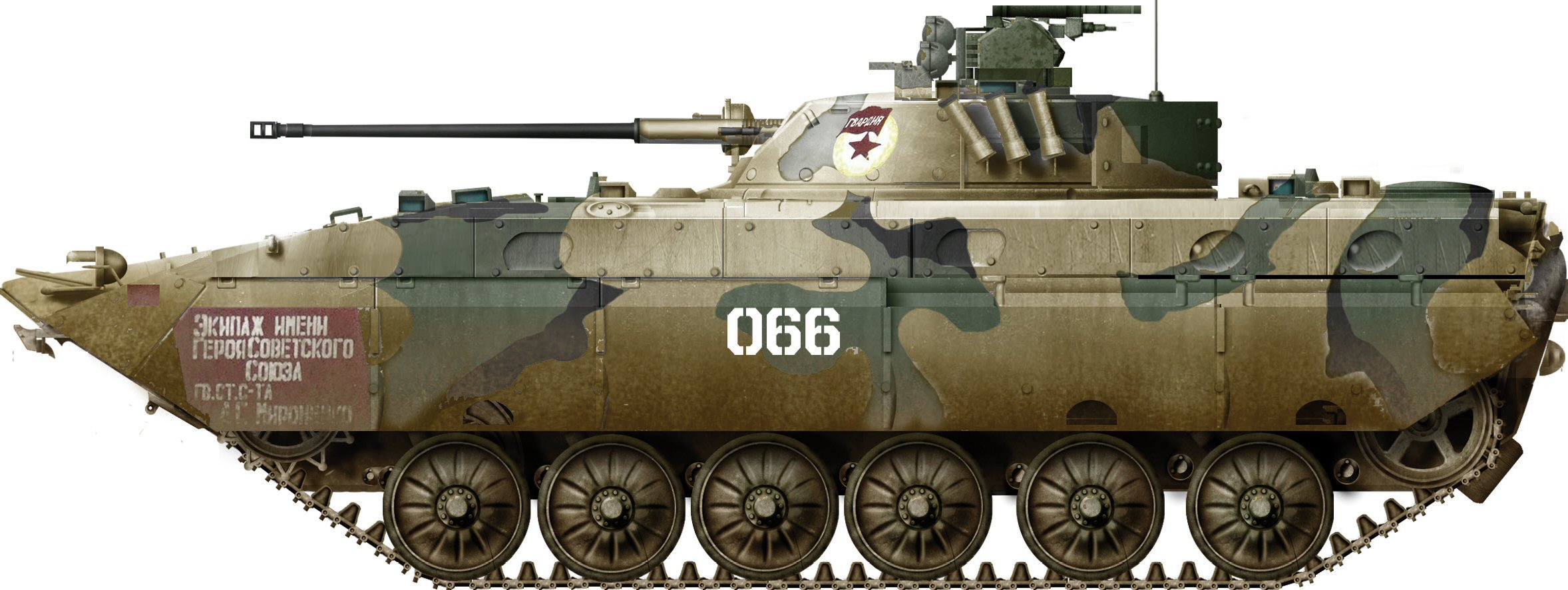
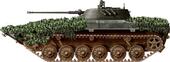
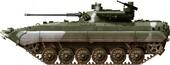
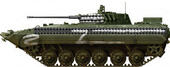
BMP-2D | |||||
|
BMP-2 |
Experience from the 1973 war in the Middle East had demonstrated the shortcomings of the basic BMP-1 design and proposed improvements were soon on the drawing board. There was much debate as to whether to retain the 73mm gun or adopt another calibre. Experience in Afghanistan soon showed that a weapon capable of high-angle elevation would be useful and thus the 30mm cannon was adopted. The hull of the base model BMP-2 remained broadly similar in layout to that of the BMP-1 while the new, larger, welded steel turret of the BMP-2 now accommodated both a commander and gunner. The 2A42 30mm calibre autocannon had a selectable rate of fire, from slow, at 200–300 rounds per minute, to fast at 550 rounds per minute, though the latter rate quickly exhausted ammunition and filled the turret with fumes. The gun was installed on a stabilised mount and was capable of near-vertical elevation but was cumbersome to reload. The co-axial armament included the usual PKT 7.62mm calibre machine gun. A launch system for the 9M113 Konkurs anti-tank guided missiles (ASCC/NATO reporting name ‘AT-5 Spandrel’) was fitted to the base model BMP-2 but rarely used in Afghanistan. This BMP-2D was assigned to the 317th Guards Airborne Regiment of the 103rd Guards Airborne Division, where it replaced old BMD-1s. (Artwork by David Bocquelet)